Showing posts with label Energy. Show all posts

Sunday, 12 December 2010

Anthony's Trail: Grundtvig Workshop Round-up

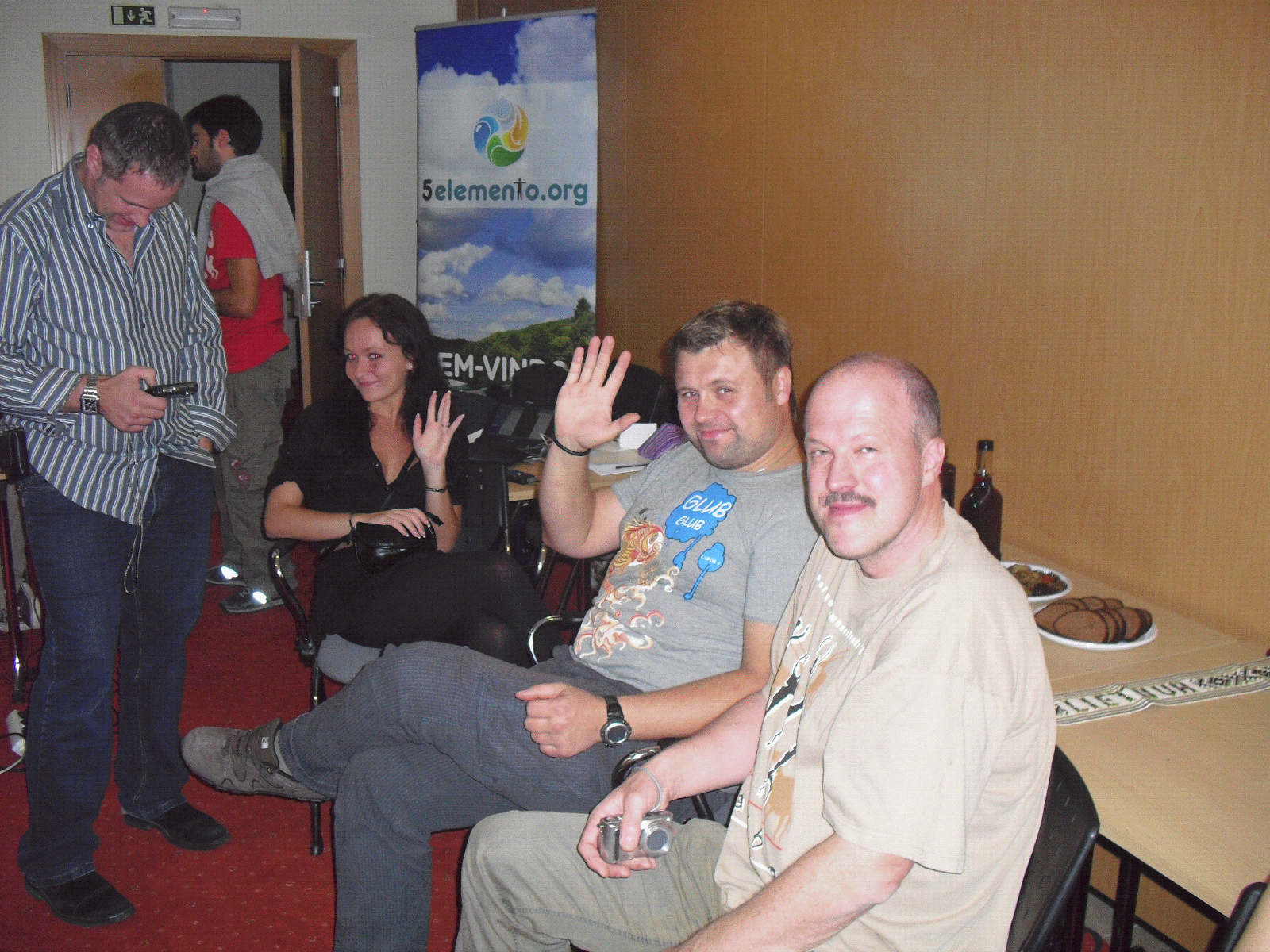
To close up these posts about the Grundtvig Workshop on Sustainable Energy I'd like to share some photos taken by Anthony during his week in Lisbon with the new friends he made from all over Europe. 

  • The Participants of the Workshop, from Italy, Latvia, Bulgaria, Romania, Hungary, Lithuanian and, of course, Malta. 
  • A sack race competition with a twist! 
  • Chiara (Italy) and Ivelina (Bulgaria) trying out some experiments at the Museum of Electricity. 
  • Pedro (Portugal) trying out a solar powered car, not a ferrari, but it works! 
  • Jose (Portugal) carrying out some energy experiments and debunking some energy myths. 
  • Ulderica, Stefano, Chiara and Fabrizio, the Italians during the inter-cultural evening. 
  • Raimond, Annija, Ivo and Juris (all from Latvia) during the inter-cutural night. 
For more info on 5elemento, the NGO that organised the fantastic workshop, or the workshop itself visit 5elemento.org or contact Greenhouse (green.uom@gmail.com

Sunday, 5 December 2010

Anthony's Trail: A Visit to Edificio Solar XXI

While I (Anthony) was in Lisbon on the Grundtvig Workshop with 5elemento, we visited an interesting "passive building" called Edificio Solar XXI. This is a building which was designed to use very little energy, virtually no external energy is used in the building. 


They did this by incoporating a variety of technology including: 
  • advanced insulation systems
  • innovative ventilation 
  • clever design of blinds and apertures to provide as much natural lighting as possible
  • solar collectors for heating water
  • photovoltaic cells, both on the wall of the building and also on the parking area (this serves as an energy source and also a shelter for cars!) 
  • earth tubes for passive cooling
  • a ventilation system which serves as heating thanks to the photovolatic cells 
  • and much more clever ideas! 

Check out the powerpoint presentation attached for an explanation on how the building was designed. This was presented to the participants of the workshop by one of the engineers that works in the building.


Ed Solarxxi 5elemento

Sunday, 28 November 2010

Anthony's Trail: Ivo's Greenhouse


In the previous Blog post we shared some hints and tips on how to reduce your energy consumption in the home. This helpful information was passed on by Anthony (Greenhouse member) who attended a Grudtvig workshop in Lisbon, which was organised by a certain 5elemento, a Portugese NGO that focuses on sustainable energy and much of the information and presentations published in the recent blogs were prepared by Jose and Pedro, our friends from 5elemento
So, we've already seen what little things we can do to make our homes more energy efficient without spending much time or effort on it. 
Now, I'd like to introduce Ivo:
(Put pic 2 here)
Ivo is from Kuldiga in Latvia, a country were the temperature is below 0'C for most of the year and where it often goes below -40'C. This kind of climate is very hard to imagine for people who live in a country with such a mild climate, where we never ever have sub-zero temperatures (except for in walk-in freezers!). To get an idea of what it's like in Latvia in winter, the water pipes often freeze up during the worst part of the winter. Soil often freezes for the metre or so under ground. Let's just say it's pretty difficult to keep warm
Ivo had an incredible idea. He decided to build his own home from scratch. Apart from the daunting idea of designing building a timber house from scratch, only with the help of family and friends, Ivo also decided to make his home as energy efficient as humanly possible. He knew this would entail a lot of planning, hard work and a good bit of money, but he didn't let that get him down and he went for it. 

One of the most important aspects that Ivo had to consider when designing his house was good insulation. He used a type of insulation very popular in Baltic States called ISOPLAAT which is a composite material which provides very effective insulation. The photo shows Ivo's wife admiring the ISOPLAAT on the half-constructed house. He also used some interesting methods of heating, he built his own floor heating (shown in the next photo) and also created a great system for his furnace which circulated the whole house


When asked whether it was honestly worth all the work to create an energy efficient home he replied simply, "100%". 


Here's a powerpoint presentation about Ivo's Green-house, in which he explains how he carried out this great work, with details on the insulation, heating systems and chimneys. 


Ivo's Home Pt 1

Ivo's Home Pt 2

Sunday, 21 November 2010

Anthony's Trail: Make your own Green-house!

In a previous blog post we promised that we'd share some hints and tips on how to lower your domestic energy consumption! In Europe, about 75% of the energy used in the home is used for space heating. Luckily, we have a very mild climate here in Malta, but in some other countries the temperature can be in the negative degress celsius for a large part of the year and can go as far down as -40'C. Many countries in Europe have issues such as frozen water pipes during the winter months. In Malta we have more of a space cooling issue in summer than a space heating issue in winter. That said, I've heard many people complain that they feel cold inside their homes in winter, despite having the AC, electric radiators or gas heaters on and I suspect that that has much to do with construction inadequacies. 


Anyway here are some tips on how to lower your energy consumption in the home: 

Change your light bulbs! Energy saving light bulbs can reduce your consumption while not affecting your quality of lighting. Older energy saving bulbs take long to heat up until they reach their full strength, but nowadays there are good bulbs that don't take anytime to heat up, they're just like regular bulbs (but better!). I use 11W energy saving bulbs that shine as much as 60W bulbs and don't take any time to "heat up". Also, it's a good idea to choose the wattage of your bulbs depending on the "activity" you use them for. Identify bulbs you use for reading and ones you need for dim lighting and select appropriate wattages. 


Reduce Vampire Power- this means switching off all equipment from standby. Many people think that this is just a myth, but really, a lot of your energy goes down the drain by leaving music systems, TVs, DVD players, mobile chargers etc etc on standby.
Buy appliances that are rated as energy efficient. Try to aim for A or A+ appliances, these are very common now and most new technology is A or A+. All domestic appliances sold in the EU should be marked with the certificate shown below. Check it - it will save you money. 
Use less energy for heating/cooling: Set the thermostats of your ACs/central heating systems to the lowest temperature which is comfortable, in winter, and the highest temperature which is comfortable, in summer. So in summer your ACs should be set at around 25'C and not 16'C. Setting the AC temperature at too low a temperature puts a lot of strain on the AC unit and is overkill. Also, wear appropriate clothing, indoors, according to the weather: wear several layers in winter and as little clothing as possible (while remaining decent!) in summer. 


    That's just the beginning. Check out the presentations, prepared by our friends at 5elemento (a Portugese NGO) attached for a long list of hints and tips for reducing your energy cosumption. Most of these are very simple and don't take any time or money and can save you money on your energy bill.
    Tips 1


    Tips 2

    Sunday, 14 November 2010

    Anthony's Trail: Renewable Energy in the EU

    88.1% of the world's energy comes from fossil fuels (in the EU 82% comes from fossil fuels, while in Malta it's 100% of course). The average person uses 2584 kwh however 77% of the world's energy is consumed by just 28% of the population. The European Union has long been trying to lower energy consumption and reduce reliance on fossil fuels, for two main reasons: 
    1. Environmental Issues (such as global warming, health effects of pollution & the damage that pollution causes to ecosystems) 
    2. Energy Dependency (most of the Union's fossil fuels are imported, resulting in a resource dependency). 


    Regarding the Environmental concerns, most of the EU member states had signed the Kyoto protocol, back in 1997, and many (15) have actually carried out the necessary cuts and measures which they promised they would, with Latvia ranking on top, cutting emissions to 48% lower than the Kyoto target. As you can see in the first graph, many countries didn't quite make the cut. Of course Malta is down at the bottom of the list alongside Cyprus for not having actually signed the protocol! 

    As for the dependency concern, Malta of course imports 100% of it's energy in the form of fossil fuels and is on the top of the list in the second chart, again alongside our friends Cyprus. 


    The EU aims to solve the problem of emissions and dependency with a two-pronged approach: reducing consumption and investing in renewable energy sources. The general public seems to have certain reservations on renewable energy in their homes, mainly because a lot of the choices (such as Photovoltaic cells and Wind Turbines) are pretty expensive! But, there are practical and easy ways to reduce your energy consumption in the home and also use more renewable forms of energy.

    In the coming blog posts we'll give some simple hints and tips as to how to lower your energy bill and help save the enviornment at the same time and also share some ideas and experiences with you. 

    Check out the powerpoint presentation, prepared by members of 5elemento (www.5elemento.org), about the state of energy in the EU. 


    Energy in the World

    Wednesday, 27 October 2010

    Anthony's Trail: The Grundtvig Workshop on Sustainable Energy in the Domestic Sector


    Anthony, a member of the Greenhouse Exec. had the opportunity to travel to Lisbon to take part in a Grundtvig workshop (http://ec.europa.eu/education/grundtvig/doc984_en.htm) organised by Portugese NGO 5elementos (the fifth element). The workshop was attended by 15 participants from all over Europe (Italy, Latvia, Hungary, Bulgaria, Romania, Lithuania and, of course, Malta) and the topic of the workshop was sustainable energy, principally in the home.

    We will be posting some of the information and experiences from this workshop here, so watch this space!

    To start off with here's a link (www.casamais.adene.pt) to an interactive program which allows you to calculate your house's/apartment's energy efficiency and also determine what your problem areas are and what impacts certain changes will have on your energy efficiency. The program is designed for Portugal, allowing you to choose from different regions of Portugal thus customising the environmental conditions. I suppose that selecting a region in the south of Portugal is the best way of approximating Malta's climatic conditions however maybe in the future we will have a similar programme designed for our little islands!

    Wednesday, 21 July 2010

    Student house gets a Camera Revamp

    It was a late and dark winter evening when some Greenhouse members were walking down the quadrangle on campus. We noticed each and every corridor and room in the Students House was switched on and we thought there were still some activities going on. We tried to push open the main door but it was locked. So we wondered why, for sanity’s sake, were all the bulbs and tubes in the building switched on when the building was obviously empty. We took a couple of pictures, sent them to KSU and enquired about the situation.

    The CCTV cameras in the building needed illumination for them to capture good images. Hmm….And CCTV cameras are vital in the building which has numerous commercial entities and which has a history of break-ins and burglary. So what was the alternative? Infrared cameras! These cameras do NOT require illumination for them to work and hence the lights can be left switched off during the night. These cameras use another range of the light spectrum, specifically infrared radiation, and not visible light as was the case with the other cameras.

    We suggested this alternative to KSU with the full understanding that this would require a major investment and would not happen overnight. KSU found the suggestion useful and embarked on a project to replace all CCTV cameras in the Students House with Infrared cameras. All cameras have been replaced and the Students House is not left switched on during the night. This saves substantial amounts of energy and therefore cuts down on greenhouse gas emissions.

    We commend KSU for this investment and augur that this will be one of many energy conserving initiative to be undertaken in the future.

    Tuesday, 16 March 2010

    European Parliament Calling for Investment in Low Carbon Tech

    The European Parliament has asked the Commission to invest more money in innovative technologies that would help cut greenhouse gasses by 20% by 2020.

    This resolution was supported by the EPP, S&D, ALDE and ECR while the GUE/NGL and Greens/EFA voted against as they argued the goals are not ambitious enough. The right wing (EFD) voted against as they said that such investments should be made at national not at EU level.

    All Maltese MEPs voted in favor of the resolution.


    But what is the resolution all about?

    The European Union must reduce its greenhouse gasses by 20% by 2020 (or 30% if other international partners take on a similar ambitious target). For this to be achieved new technologies must be used as a solution to the current scenario where fossil fuel is burnt with carbon dioxide, the most abundant greenhouse gas, being released unattended into the atmosphere- the main cause of climate change.

    Research and development in this area is being given a lot of importance with millions of euros being invested throughout EU research institutes to either fine tune current low carbon technologies or invent new ones.

    The six European Industrial Initiatives (EII) are, as the name implies, initiatives undertaken in six areas which can help reduce greenhouse gasses from finding their way into the atmosphere. These are solar energy, wind energy, bio-energy, carbon dioxide capture, transport and storage, the electricity grid and sustainable nuclear fission.
    Over the next 10 years, the European Commission identified the need for investments in these areas of:
    • 6 billion euros for wind energy;
    • 16 billion euros for solar energy;
    • 2 billion euros for electricity networks;
    • 9 billion euros for bio-energy;
    • 13 billion euros for carbon capture and storage;
    • 7 billion euros for nuclear fission and
    • 5 billion euros for fuel cells and hydrogen

    There is also the SET Plan (Strategic Energy Technology Plan) which aims to accelerate the development and deployment of cost-effective low carbon technologies. This has the potential to turn the EU into an innovative economy, creating thousands of new jobs.

    In this resolution, the European Parliament (EP) urges more investment for both the EII and the SET-Plan to continue being implemented at the fastest possible rate. It reiterates that those technologies which have the greatest potential to create jobs should be given priority.
    The EP is calling, amongst others, for the urgent establishment of a funding timetable by the Commission and the Member States of the resources they will commit to ensure that funds start flowing as from 2010. It is also calling to use the 300 million euros set aside from a mechanism in the Emission Trading Scheme (ETS) to support carbon capture and storage and innovative renewable sources of energy and for the European Investment Bank to increase its capacity to offer loans to energy projects.
    The EP “asks the Commission, in close cooperation with the EIB, to come forward without delay, and by 2011 at the latest, with a comprehensive proposal for an instrument to finance renewable energy and energy efficiency projects and smart grids development”.

    I would like to draw the attention to one amendment that was proposed by Greens/ALE:

    Motion for a resolution

    Amendment

    5. Underlines that, in the light of the economic crisis, investing in those new technologies that have the greatest potential for job creation should be a priority; underlines that it will lead to the creation of markets, generate new revenue streams and contribute to the development of the EU’s economy and competitiveness; stresses, finally, that it will, furthermore, strengthen the security of the EU’s energy supply and reduce its energy dependency on a limited number of energy resources, suppliers and transport routes;

    5. Underlines that, in the light of the economic and the employment crisis, as well as the need for global GHG emissions to peak by 2015, the EU must only invest in those new safe technologies and implement those roadmaps which will have an immediate impact in terms of employment, social cohesion and climate protection; underlines that it will lead to the creation of markets, generate new revenue streams and contribute to the development of the EU’s economy and competitiveness; stresses, finally, that it will, furthermore, strengthen the security of the EU’s energy supply and reduce its energy dependency on a limited number of energy resources, suppliers and transport routes;

    *The phrases in bold are those which were amended

    This amendment was voted against by the majority of Parliament. Can we make our greenhouse gasses peak by 2015? Is it too ambitious? What will be the repercussions if we don’t? What is needed for this to happen?


    With regards to the resolution passed by the EP, I think Malta is in dire need of low carbon technologies. We are finally starting to invest in wind farms, PVs, energy efficiency, smart grids and more. Although limited in size, it is still a pity that we are practically completely depended on fossil fuels for our energy generation. If low carbon technologies come our way, we can do much more. We can extract energy from our seas for example. We can start using hydrogen fuel to power our cars. We mustn’t be afraid to change our way. The possibilities are only limited by human creativity and we’d better put our money where our mouth is because catastrophic climate change is not as distant as we thought it might be.

    _________________________________________________________________

    During this same week questions relating to the UN report on the War on Gaza or Operation Cast Lead as it was code named had been sent to our elected representatives. Each one failed to reply to our questions even after reminders where sent.

    Furthermore, a question relating to the Financial Transaction Tax (a tax claimed to have the potential of funding action against climate change and poverty) was replied only by Dr Edward Scicluna in his capacity as member of the Committee on Economic and Monetary Affairs. The following are extracts from his statements in the Committee:

    Since then, the Commission has been investigating the subject, and we are highlighting here the large range of questions needing to be answered. There have been calls, including in the G20 last September, to make the financial sector pay for setting up stability funds and recompense for the damage that they have caused to the real economy. President Barroso has suggested using a global financial levy to fund environmental projects. The original Tobin Tax idea of using a financial transaction tax for development aid has also strongly resurfaced. .........
    ....... One idea concerning the tax is that nobody would notice because it is so small in each instance. On the other hand, others suggest it should be used to deter excessive transactions. It seems to my committee that if the end amount collected is large – and the sums suggest so – then somebody somewhere will actually be paying. ...............
    ......... . If the tax is collected in London for a derivative transaction that is uncosted, to somewhere else in the world, who says where to spend it? This question may be easier to answer if it goes to a financial stability cause in which the payers are obviously participating than if it is to go outside the financial sphere, such as to environmental projects or development aid. ...........

    Further reading is suggested on this matter as the form and extent of such a tax will imply from another EU wide form of taxation and the possibility of a tax linked directly to an international Humanitarian cause. Civil Society has already mobilised in support of such a tax form through the Robin Hood Tax Campaign. Their video can be see here:

    Saturday, 13 February 2010

    Energy Conservation @ UoM – Every bit counts!

    We all would love to justify our helplessness and laziness but pointing fingers at who is in authority or at the society in which we live in won’t help. So much is in fact said about our University. Sweeping statement such as, “they waste energy all the time! It’s right under their noses! Who is it that pays for their bills? What It is a Public institution so….”

    And so the rambling goes. But is the University so out of touch with today's realities…. And on all matters?

    Think again!

    Following the ‘Call for Energy Auditing’ run by Greenhouse together with 9 other organisations and featured also on Insite. We had recovered from the Rector’s Delegate for Logistics a study which had just been running for a year. This study was the first phase of a project undertook in 2007 which analysed all the main forms of energy consumption at university and saw where the bulk of energy consumption took place. This involved metering every building and air conditioner separately and compiling data. It also helped work out a strategy to be implemented over time.

    The second part took place in 2008 where wasteful practises where reduced, such as replacing fluorescent tubes to T5 bulbs with a payback period of 2 years and installing motion detectors together with the light circuit. There were also members of the staff selected to run the various projects in their respective buildings and who later would see through the implementation of future projects. In all 2008 saw a 5% reduction in energy consumption at University.

    During last year 2009 an additional cut of 5% in energy consumption had been achieved. Through the expansion of the scope of the previous year’s energy saving measures which started in 2008. This reduction was achieved even though there was the expansion of University facilities and the investment in new electric equipment for various facilities.

    Later during the opening of the new academic year in September 2009 a project proposal by the University was accepted under the European Regional Development Fund. The project “Implementing Green Activities at the University of Malta” seeks to invest € 4.4million over a number of years. Through the investment in Photovoltaic Systems expected to generate 20-25% of present energy needs to the installation of Power Factor Correction Equipment in each building of the University. Expectations are running high for this project which is expected to be primarily for research purposes.

    Furthermore, a similar metering exercise on water consumption was run during the second half of 2008 where it identified water leakages of around 30% of the University recorded level of consumption. This leak has been bypassed and minimized until the necessary repairs will be undertaken by the Water Services Corporation during the summer period.

    In conclusion energy consumption has dropped by 10% over the last 2 years and 20-25% of the remaining consumption is expected to be produces through renewable energy. This is definitely a first for a Maltese institution and now!! What are you and your friends doing about your energy consumption?

    Ever bit counts in energy conservation.

    For additional information visit the following site.

    Monday, 26 January 2009

    Call for Energy Audit