Showing posts with label Education. Show all posts

Sunday, 12 December 2010

Anthony's Trail: Grundtvig Workshop Round-up

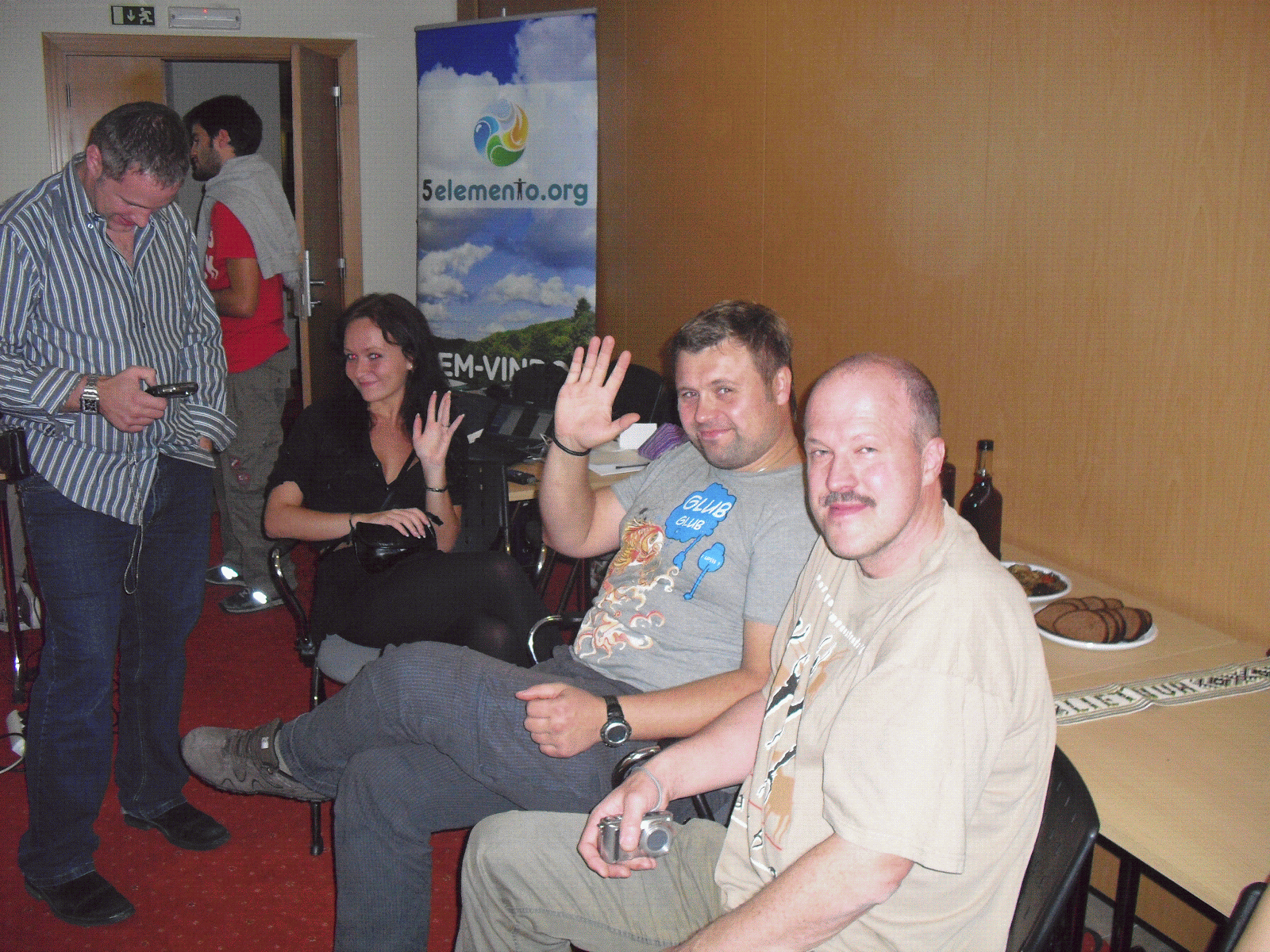
To close up these posts about the Grundtvig Workshop on Sustainable Energy I'd like to share some photos taken by Anthony during his week in Lisbon with the new friends he made from all over Europe. 

  • The Participants of the Workshop, from Italy, Latvia, Bulgaria, Romania, Hungary, Lithuanian and, of course, Malta. 
  • A sack race competition with a twist! 
  • Chiara (Italy) and Ivelina (Bulgaria) trying out some experiments at the Museum of Electricity. 
  • Pedro (Portugal) trying out a solar powered car, not a ferrari, but it works! 
  • Jose (Portugal) carrying out some energy experiments and debunking some energy myths. 
  • Ulderica, Stefano, Chiara and Fabrizio, the Italians during the inter-cultural evening. 
  • Raimond, Annija, Ivo and Juris (all from Latvia) during the inter-cutural night. 
For more info on 5elemento, the NGO that organised the fantastic workshop, or the workshop itself visit 5elemento.org or contact Greenhouse (green.uom@gmail.com

Sunday, 5 December 2010

Anthony's Trail: A Visit to Edificio Solar XXI

While I (Anthony) was in Lisbon on the Grundtvig Workshop with 5elemento, we visited an interesting "passive building" called Edificio Solar XXI. This is a building which was designed to use very little energy, virtually no external energy is used in the building. 


They did this by incoporating a variety of technology including: 
  • advanced insulation systems
  • innovative ventilation 
  • clever design of blinds and apertures to provide as much natural lighting as possible
  • solar collectors for heating water
  • photovoltaic cells, both on the wall of the building and also on the parking area (this serves as an energy source and also a shelter for cars!) 
  • earth tubes for passive cooling
  • a ventilation system which serves as heating thanks to the photovolatic cells 
  • and much more clever ideas! 

Check out the powerpoint presentation attached for an explanation on how the building was designed. This was presented to the participants of the workshop by one of the engineers that works in the building.


Ed Solarxxi 5elemento

Sunday, 28 November 2010

Anthony's Trail: Ivo's Greenhouse


In the previous Blog post we shared some hints and tips on how to reduce your energy consumption in the home. This helpful information was passed on by Anthony (Greenhouse member) who attended a Grudtvig workshop in Lisbon, which was organised by a certain 5elemento, a Portugese NGO that focuses on sustainable energy and much of the information and presentations published in the recent blogs were prepared by Jose and Pedro, our friends from 5elemento
So, we've already seen what little things we can do to make our homes more energy efficient without spending much time or effort on it. 
Now, I'd like to introduce Ivo:
(Put pic 2 here)
Ivo is from Kuldiga in Latvia, a country were the temperature is below 0'C for most of the year and where it often goes below -40'C. This kind of climate is very hard to imagine for people who live in a country with such a mild climate, where we never ever have sub-zero temperatures (except for in walk-in freezers!). To get an idea of what it's like in Latvia in winter, the water pipes often freeze up during the worst part of the winter. Soil often freezes for the metre or so under ground. Let's just say it's pretty difficult to keep warm
Ivo had an incredible idea. He decided to build his own home from scratch. Apart from the daunting idea of designing building a timber house from scratch, only with the help of family and friends, Ivo also decided to make his home as energy efficient as humanly possible. He knew this would entail a lot of planning, hard work and a good bit of money, but he didn't let that get him down and he went for it. 

One of the most important aspects that Ivo had to consider when designing his house was good insulation. He used a type of insulation very popular in Baltic States called ISOPLAAT which is a composite material which provides very effective insulation. The photo shows Ivo's wife admiring the ISOPLAAT on the half-constructed house. He also used some interesting methods of heating, he built his own floor heating (shown in the next photo) and also created a great system for his furnace which circulated the whole house


When asked whether it was honestly worth all the work to create an energy efficient home he replied simply, "100%". 


Here's a powerpoint presentation about Ivo's Green-house, in which he explains how he carried out this great work, with details on the insulation, heating systems and chimneys. 


Ivo's Home Pt 1

Ivo's Home Pt 2

4 Environmental NGOs launch the 'Fish4Tomorrow' Campaign

Over the past few months a number of local NGOs have come together to create the Fish4Tomorrow campaign. The main aim of this campaign is to raise awareness on sustainable fishing within the local context. It also plans to provide guidelines to fish consumers helping them determine which Maltese restaurants serve sustainably caught fish. This idea is similar to the international Fish2Fork campaign (3). Also, Coalitions such as Ocean 2012 (2) which includes high profile members such as Greenpeace, Birdlife International, WWF as well as local NGOs like Nature Trust, Greenhouse and Sharklab (Malta) are on the forefront of raising awareness by campaigning for entire reforms such as the 2012 CFP Reform (Common Fisheries Policy Reform) which aims for healthy oceans and putting an end to overfishing amongst other issues. All this is done in the hope of ensuring that our oceans are preserved for us and our future generations.


Despite its large size, the ocean is not inexhaustible or exempt from the effects of human activity. Over the past decade or so the ocean has suffered irreparable damage and one of the major components is the issue of overfishing. Due to factors such as Globalisation, high levels of demand for certain species of fish have come about. Such is this demand, that governing bodies like the EU have pumped large amounts of money into companies providing them with highly sophisticated equipment and fishing vessels. This in turn has left fish with not enough time to reproduce and therefore giving the species very little chance of survival. The Atlantic Bluefin Tuna (Thunnus Thynnus) is possibly one of the most high profile cases of overfishing the world is currently facing. In fact ICCAT (International Commission for the Conservation of Atlantic Tuna) have assessed that there has been a strong decline in its spawning stock biomass since 1993.


Catch limits of Bluefin Tuna are currently higher than scientific advice. In 2010 this was averaged to be at 34% higher. In attempt to counteract this, a quota is set by ICCAT which determines the amount of Tuna that is allowed to be caught per year. In 2008, this was set at 28,500 tonnes and has since been reduced to 13,500 tonnes for 2010. This, scientists believe, is still not low enough to give the Tuna a fighting chance of survival. Currenty, ICCAT is facing a lot of criticism from European countries like Malta, Italy and Spain for suggesting a significant drop in the quota down to 6,000 tonnes for 2011 and has had to reconsider this decision since.


Malta is one of the countries which is on the forefront of this issue since it plays one of the most important roles in the ranching of the Tuna which comes into the Mediterranean to breed. In 2006, the MCFS estimated the Bluefin tuna production in Malta to be at 3,000 tonnes, worth around €46,000,000 (1). One of the main reasons why Tuna stocks have been depleting so rapidly is because it is so far impossible to farm the fish, it being a migratory animal. This means the tuna is caught and ranched in large amounts, fattened for 6 months and finally exported, mainly to Japan.


Greenhouse
Nature Trust (Malta)
Shark Lab (Malta)
Get Up, Stand Up


1) http://www.fao.org/fishery/countrysector/naso_malta/en
2) http://www.ocean2012.eu/OCEAN2012
3) http://www.fish2fork.com/


Media Features: Di-ve Media

Sunday, 21 November 2010

Anthony's Trail: Make your own Green-house!

In a previous blog post we promised that we'd share some hints and tips on how to lower your domestic energy consumption! In Europe, about 75% of the energy used in the home is used for space heating. Luckily, we have a very mild climate here in Malta, but in some other countries the temperature can be in the negative degress celsius for a large part of the year and can go as far down as -40'C. Many countries in Europe have issues such as frozen water pipes during the winter months. In Malta we have more of a space cooling issue in summer than a space heating issue in winter. That said, I've heard many people complain that they feel cold inside their homes in winter, despite having the AC, electric radiators or gas heaters on and I suspect that that has much to do with construction inadequacies. 


Anyway here are some tips on how to lower your energy consumption in the home: 

Change your light bulbs! Energy saving light bulbs can reduce your consumption while not affecting your quality of lighting. Older energy saving bulbs take long to heat up until they reach their full strength, but nowadays there are good bulbs that don't take anytime to heat up, they're just like regular bulbs (but better!). I use 11W energy saving bulbs that shine as much as 60W bulbs and don't take any time to "heat up". Also, it's a good idea to choose the wattage of your bulbs depending on the "activity" you use them for. Identify bulbs you use for reading and ones you need for dim lighting and select appropriate wattages. 


Reduce Vampire Power- this means switching off all equipment from standby. Many people think that this is just a myth, but really, a lot of your energy goes down the drain by leaving music systems, TVs, DVD players, mobile chargers etc etc on standby.
Buy appliances that are rated as energy efficient. Try to aim for A or A+ appliances, these are very common now and most new technology is A or A+. All domestic appliances sold in the EU should be marked with the certificate shown below. Check it - it will save you money. 
Use less energy for heating/cooling: Set the thermostats of your ACs/central heating systems to the lowest temperature which is comfortable, in winter, and the highest temperature which is comfortable, in summer. So in summer your ACs should be set at around 25'C and not 16'C. Setting the AC temperature at too low a temperature puts a lot of strain on the AC unit and is overkill. Also, wear appropriate clothing, indoors, according to the weather: wear several layers in winter and as little clothing as possible (while remaining decent!) in summer. 


    That's just the beginning. Check out the presentations, prepared by our friends at 5elemento (a Portugese NGO) attached for a long list of hints and tips for reducing your energy cosumption. Most of these are very simple and don't take any time or money and can save you money on your energy bill.
    Tips 1


    Tips 2

    Sunday, 14 November 2010

    Anthony's Trail: Renewable Energy in the EU

    88.1% of the world's energy comes from fossil fuels (in the EU 82% comes from fossil fuels, while in Malta it's 100% of course). The average person uses 2584 kwh however 77% of the world's energy is consumed by just 28% of the population. The European Union has long been trying to lower energy consumption and reduce reliance on fossil fuels, for two main reasons: 
    1. Environmental Issues (such as global warming, health effects of pollution & the damage that pollution causes to ecosystems) 
    2. Energy Dependency (most of the Union's fossil fuels are imported, resulting in a resource dependency). 


    Regarding the Environmental concerns, most of the EU member states had signed the Kyoto protocol, back in 1997, and many (15) have actually carried out the necessary cuts and measures which they promised they would, with Latvia ranking on top, cutting emissions to 48% lower than the Kyoto target. As you can see in the first graph, many countries didn't quite make the cut. Of course Malta is down at the bottom of the list alongside Cyprus for not having actually signed the protocol! 

    As for the dependency concern, Malta of course imports 100% of it's energy in the form of fossil fuels and is on the top of the list in the second chart, again alongside our friends Cyprus. 


    The EU aims to solve the problem of emissions and dependency with a two-pronged approach: reducing consumption and investing in renewable energy sources. The general public seems to have certain reservations on renewable energy in their homes, mainly because a lot of the choices (such as Photovoltaic cells and Wind Turbines) are pretty expensive! But, there are practical and easy ways to reduce your energy consumption in the home and also use more renewable forms of energy.

    In the coming blog posts we'll give some simple hints and tips as to how to lower your energy bill and help save the enviornment at the same time and also share some ideas and experiences with you. 

    Check out the powerpoint presentation, prepared by members of 5elemento (www.5elemento.org), about the state of energy in the EU. 


    Energy in the World

    Monday, 5 July 2010

    Life in a Nitrate Vulnerable Zone

    The Ministry for Resources and Rural Affairs (MRRA) recently published the Consultation Document on the second Nitrates Action Programme for Malta. The MRRA asked for NGOs and other stakeholders to review this document and to pass on any recommendations to the ministry - Greenhouse has discussed the changes in the Action Programme and passed them on to the Ministry. Before delving into the details of the Action Programme and the recommendations brought forward by the Greenhouse team, letʼs look into what nitrate pollution is and why people in Malta should care about a Nitrates Action Programme, in the first place.

    The main concerns regarding Nitrate Pollution involve the contamination of water by large concentrations of nitrates. There are three main reservoirs which are typically polluted by nitrates. The first two are the marine environment and inland freshwater habitats, where an excess of nitrate leads to algal blooms and c resulting in a potentially catastrophic changes in the biodiversity of the habitats. [1] Now this might be alarming enough but the effects of nitrate pollution on groundwater supplies are far more frightening for the man in the street who may not care so much for fragile marine ecosystems. High concentrations of nitrates in drinking water can lead to methemoglobinemi and gastric and intestinal cancer [2]; considering Malta gets around half of itʼs drinking water from groundwater sources [3], it is quite important that we protect these sources from nitrate pollution.

    The recommended maximum of nitrates in groundwater, set by the EUʼs Nitrates Directive is at 50mg/L [3,4], however out of Maltaʼs 15 Groundwater bodies (GWBs) 11 are above the limit (8 of them are over double the limit). It is worth mentioning that out of the four bodies not over the limit, one is only 0.6mg/L short of the limit, while the concentration for another body (the Marfa GWB) has not been calculated yet and is expected to be above the limit. So really, only two ground water bodies can be considered to be not polluted by nitrates.[3] This is all outlined in detail within the second section of the Action Programme.

    In 2008, the MRRA commissioned a study to determine the source of nitrates in Maltaʼs Groundwater bodies, which was carried out by the British Geological Survey (BGS). This interesting study, involving isotopic signatures of oxygen and nitrogen found that most of the nitrates found in GWBs originate from cultivated areas and also from manure dumps. [5] It has long been supposed that agricultural practices were the cause for nitrate pollution of local water bodies, in fact the whole scope of the first Nitrates Action Programme started in 2004 was based on agricultural management practices and the setting up of the Code of Good Agricultural Practice (CoGAP) (another major aim of the action programme was to set up rugged monitoring schemes to ensure scientific data is available).

    As the main document suggests Malta has a massive problem with nitrate pollution, especially in our Groundwater bodies, which has no doubt been caused by poor agricultural practices (using too much fertiliser, illegal dumping or poor storage of manure, etc). Here are the solutions (in summary) as put forward by the MRRA, built on the original Nitrates Action Programme (2004) with some practical amendments:

    • Application of fertiliser (both organic and inorganic) is prohibited between 15th October and 15th March.
    • Application of fertiliser is prohibited on land which is close to watercourses or where the soil condition or slope suggests that there is a significant risk of the fertiliser being swept away by runoff.
    • Application of slurry is prohibited
    • Application of fertilisers is prohibited within a 5m radius of fresh watercourses of any kind and 50m from a borehole in use for public water supply.
    • Application of fertilisers shall be based on fertilisation planning taking into consideration the balance between the foreseeable nitrogen requirements of the crops and the nitrogen supply to the crops from the soil, water and from fertilisation.
    • Inorganic and organic fertilisers shall be applied close to sowing and splitting of fertiliser application is recommended whenever possible.
    • The amount of “total nitrogen” applied from livestock manure, including excreta by animals themselves, shall not exceed 170 kg N/ha per year.
    • The capacity of storage facilities for livestock manure of a holding shall be sufficient and adequate to provide for the storage of all the livestock manure which is likely to require storage between the 15th October to 15th of March.
    • Manure shall be stored in a leak-proof, covered storage clamp which is connected to a cesspit. The Cesspits must be leak-proof, covered and must be sufficient to collect all urine and washings for at least 15 days (both cesspits and manure clamps must be certified by a warranted architect).
    • Crop rotation shall be practised where necessary.
    • Farm holdings with an area >1 ha and under intensive irrigated cultivation shall have a Nutrient Management Plan.
    • Users of organic and/or inorganic fertilisers shall be registered with the competent authority responsible for nitrates.
    • Users of organic or inorganic fertilisers shall be required to attend a compulsory course on the use of fertilisers.
    • All sales and purchases of organic and inorganic fertilisers shall be notified to the competent authority responsible for Nitrates.
    • All importers, distributors and resellers of fertilisers shall be registered with the competent authority.

    Greenhouse gave five recommendations for the ministry to consider:

    1. The banning of ammonium nitrate fertilisers; ammonium nitrate is very soluble and is often washed away before the crops can absorb it leading to a high degree of nitrate pollution.
    2. Encouraging the use of Slow-release fertilisers, such as methylene urea, which are less susceptible to being washed away and into the water table.
    3. Encouraging and providing incentives for proper crop management with crop rotation utilising leguminous plants to provide natural sources of nitrates.
    4. The removal of the point banning fertiliser application during the rainy season; although this ban would be beneficial it is most probably quite impractical especially since farmers could apply an excess of fertiliser prior to the ban, causing just as much damage. We are inclined to believe that such a ban would result in an unnecessary burden on the farmer.
    5. Awareness on the damage of excess-irrigation and monitoring the water consumption for irrigation could help reduce nitrate pollution by slowing down the rate at which fertiliser dissolves. Metering and other enforcement measures could be used along with educational campaigns.

    It was found, by the BGS, that the time that water spends in the aquifer in Malta is very long (15-40 years in Malta and 25-60 years in Gozo) which, when coupled with the long time it takes for nitrates to reach the water table, means that even if even all nitrate-producing activities could be stopped tomorrow, it would take decades to flush out nitrate to an acceptable level.[Stuart, Marianne (BGS). Going Underground. Planet Earth (Summer 2009) - National Environment Research Group (UK)]
    In other words, we will be living in a Nitrate Vulnerable Zone for many years to come.

    Sunday, 27 June 2010

    MEP Watch - Food Labelling: Know What You're Buying

    Food labelling must be easily recognisable, legible and understandable for the average consumer’(Amendment 67).

    When we go shopping for food from our supermarkets, we may look at a particular product and ask ourselves: ‘Is this good for me?’ ‘Should I pick something healthier than this?’ ‘Maybe this is not too bad afterall?’

    Well, the European Parliament tried to make this frequent moment in our life easier. Food labeling was discussed and some very important results came out of it.

    It is important to note that this vote covered almost every aspect of labeling- from the position of the labeling to what should be written, in what language etc. etc.

    I went over the amendments and it wasn’t an easy task at all-there were over 300 of them! I picked up what I think are the most relevant for us as consumers and those that were either interesting to give a second thought about or those which created a bit of a heated debate.

    Firstly, it is useless to read the nutritional information on a food item without having any idea of the difference between proteins and carbohydrates, that there are different types of fats and the limit above which salt can become dangerous. Thus amendment 4 states that

    Education and information campaigns are an important mechanism for improving consumer understanding of food information.”
    This amendment was adopted by the majority of the European Parliament.

    Amendment 6 excludes a set of parties which are involved with the food sector from following the regulations set out. These are farmers which market directly their own products and providers of mass catering services. The reason for the former is that farmers would be overstretched if they had to go through all the process of labeling their own products- and since farmers do not use extra ingredients or other additives this is understandable. The mass catering services are not obliged to follow these regulations because there are no standardized procedures for them and ingredients change all the time. This amendment was adopted by the majority of the European Parliament.

    Amendment 13 requires products which claim they have some particular physical benefits- for example cereal flakes claiming that they lead to weight loss- to have these claims accompanied by a diet plan explaining the conditions under which these results may be obtained. This amendment was adopted by the majority of the European Parliament.

    There is no need to comment on amendment 16 which states that “It is possible to envisage consumers obtaining additional information via terminals placed in supermarkets. Those terminals would, by reading the barcode, furnish information about the product concerned. Likewise, it is possible to envisage consumers accessing additional information via a web page on the Internet.This amendment was adopted by the majority of the European Parliament.

    Article 37 of the text specifies that

    To appeal to the average consumer and to serve the informative purpose for which it is introduced, and given the current level of knowledge on the subject of nutrition, the information provided should be simple and easily understood. Research has indicated that consumers find the information in the principal field of view or ‘front of pack’ is useful when making purchasing decisions. Therefore, to ensure that consumers can readily see the essential nutrition information when purchasing foods such information should be in the principal field of view of the label.”

    A very important amendment is amendment 251 which refers to GMOs. With the advent of GMO cultivation behind the door for Europeans, consumers have the right to know if the product they’re consuming is genetically modified. This amendment states that

    Operators in the catering sector and anyone providing food products shall inform consumers whenever the product intended for consumption is a GMO product and/or contains derivatives and substances that may be classified as GMOs.

    FROM THE FIVE MALTESE MEPS ONLY JOHN ATTARD MONTALTO VOTED IN FAVOUR OF THIS AMENDMENT. THIS AMENDMENT WAS DEFEATED OVERALL.

    Another amendment which may be very interesting to ponder about and which is the first in its field is amendment 266. This amendment combines food production with its source and its potential social impacts by letting consumers know if their food has been produced under conditions such as child labour, forced labour, discrimination etc. by including a percentage value which would be set to 0 if a guarantee can be given on the absence of these practices. Related with this is amendment 271 which states that

    it shall be admissible to provide information on environmental, social and ethical considerations regarding foodstuffs.

    BOTH THESE AMENDMENTS WERE VOTED AGAINST BY THE MAJORITY OF PARLIAMENT.

    Amendments 272, 288 and 314 were perhaps the most hotly debated. They provided for the possibility of including a coloured scheme for nutritional information to give consumers a better schematic representation of what ingredients they should be cautious about and make the information more understandable to consumers. In amendment 314 it was suggested that
    the text "Low", "Medium" or "High" in combination with the colours green, amber and red”.

    SIMON BUSUTTIL AND DAVID CASA VOTED AGAINST THIS COLOR-CODED SCHEME WHILE JOHN ATTARD MONTALTO, LOUIS GRECH AND EDWARD SCICLUNA VOTED IN FAVOUR. THIS SCHEME WAS DEFEATED OVERALL AND NEITHER OF THE AMENDMENTS MADE IT THROUGH TO THE FINAL ADOPTED TEXT.

    Through these texts the European Parliament even rejected these coloured schemes applied at national levels.

    Some other amendments which one would do well to notice include:

    • Amendment 10 states that “mandatory food labelling should be confined to basic information which is demonstrably of great interest to the majority of consumers” and this is done “to avoid unnecessary packaging waste” and “to enable food information law to adapt to changing consumers' needs for information”.

    ADOPTED

    • In line with amendment 4 discussed above, amendment 26 states that” The mandatory provision of nutrition information on the front and back of the packaging should be supported by actions by Member States such as a nutritional action plan as part of their public health policy, which will provide specific recommendations for nutrition education for the public and support informed food choice.

    ADOPTED

    • Amendment 33 calls on a ban on artificial trans fatty acids- the consumption of which are directly related to overweight and obesity. Until such a ban enters into force, the labeling of this ingredient should be mandatory.

    THIS AMENDMENT WAS VOTED AGAINST BY THE MAJORITY OF THE EUROPEAN PARLIAMENT.

    • Amongst other amendments focusing on the country of origin of foods, amendment 65 states that “For meat and foods containing meat, the country of origin shall be defined as the country in which the animal was born, reared for most of its life, and slaughtered. If different, all three places shall be given when reference is made to the country of origin.

    THIS AMENDMENT WAS VOTED AGAINST BY THE MAJORITY OF THE EUROPEAN PARLIAMENT.

    • If the product contains an ingredient which is an ‘imitation’, for example cheese made from vegetable oil, amendment 78 states that ‘the packaging must prominently bear the marking 'imitation' or 'produced with’.

    ADOPTED

    • Deceiving clauses on packaging should be reduced through amendment 79 which doesn’t allow packaging to highlight normal properties of food as specific characteristics. For example, fruit gums cannot bear the slogan ‘fat-free’ because fruit gums contain no fat by nature.

    ADOPTED

    • Article 16 of the text adopted explicitly states that ‘… mandatory food information shall appear in a language easily understood by the consumers of the Member States where a food is marketed.’ You cannot have information appearing only in Arabic if you live in Malta.

    • The word ‘nano’ must be indicated for products containing nanomaterials according to amendment 130.

    ADOPTED

    • The term ‘vegetarian’ should not be applied to foods that are, or are made from or with the aid of products derived from animals that have died, have been slaughtered, or animals that die as a result of being eaten. The term ‘vegan’ should not be applied to foods that are, or are made from or with the aid of, animals or animal products (including products from living animals)- Amendment 175.

    ADOPTED

    Votes were also passed to ask producers of processed foods, such as biscuits and prepared meals, to indicate on the front packaging the content of energy, salt, sugar, fat and saturated fat together which should be accompanied by the guideline daily amounts and expressed with values per 100g or per 100ml.

    This vote was preceded by huge pressures from the food and drink industry. The industry invested more than 1 billion euros to lobby to block the coloured scheme for products- a figure denied by the Confederation of the Food and Drink Industries of the EU.

    Corporate Europe Observatory said:

    Food industry lobbyists have bombarded MEPs with information about the labelling scheme, in the biggest lobbying campaign seen in Brussels in recent years,” and that industrial lobbyists managed to "drown out the message from public health campaigners on a scale of 100 to 1."

    Friday, 23 April 2010

    Treasures within reach - the children investigate

    Here’s what happened.

    We were invited by Centru L-iSperanza’s coordinator- Earl- to organize an environmental treasure hunt at Wied il-Għasel for children aged 6-11.

    So we were faced with this challenge- how can you combine the environment, science, fun and hiking?

    The first thing that we did was to go to the valley- a beautiful valley cutting across Mosta. Simone, Joseph and myself went for a hike one Sunday afternoon to check what we can come up with and what plant species are present there.

    Our hike didn’t occur without some mishaps:

    For example…this is me with my hair caught up in bramble (a thorny, climbing plant):


    …while this is Simone who has just tripped over reeds:


    OK! We were done! We got the idea and it was time to put it all together.

    This is what we did. We took 18 plant species from around the valley. For each plant species we prepared a paper. This paper would serve as the clue for the hikers. In the paper will be the name of the plant, a simple question about this plant the answer of which the children had to insert in a crossword and a practical activity that the children had to do. For example for one tree in particular, we asked what color were the flowers and we asked the children to cut two leaves from this tree and place in a sampling bag.

    The paper was placed in an envelope and attached to the plant/tree in question. This we did for two groups- an orange and a purple group (we tried to avoid political colors ;-) ).


    So now we had 18 floral specimens with 36 envelopes (2 groups) attached to them.


    And the day arrived. Simone, Joseph and myself met an hour and a half before the group of children had to meet us. We went around the valley tying the clues in the envelopes to the different trees and plants:


    This is me attaching a balloon to a reed for one of the practical activities as discussed above:


    ….AND THE GROUP ARRIVED…..the children, many of them with their parents, armed with caps, notebooks and lunch surrounded us and the cheer of enthusiasm could be heard ringing in that silent Sunday hum of that early morning.


    We divided the group into two according to age. The young group was entrusted to Simone while I took the other group with slightly older children. We briefed them on what will happen during the hike:


    …AND OFF WE WENT….

    One by one they found the hanging clues, opened the envelopes, answered the questions and did what was required of them. It is good to point out that this was NOT a competition and the ‘winner’ didn’t get any reward.


    One of the practical activities instructed the children to draw a leaf from a tree so as to appreciate and look closer at the shape and intricacies of something they always took for granted:


    The two groups rambled across the pathways bordered by flowers and a huge variety of plants in that gorgeous spring morning:


    And the children’s curiosity had us answering question after question about all sorts of things:


    A deserved lunch break was enjoyed in the shade of a carob tree while the children were careful not to drop any wrappers among the plants they were starting to understand:


    And after two and a half hours the hike ended. The children, although tired and weary, were still running after each other, eating their last pieces of sandwiches and engaging with us on some point they missed out during the hike.


    Joseph supported us throughout the hike, engaging with children and capturing these photos. He also took it upon himself to clean the place:


    But that was not all. Earl invited us to walk to Centru l-iSperanza and ask the children some questions on their experiences and the lessons they learned. We opened the sampling bag and we explained some features of the local flora- its adaptation to water stress, its modifications to deter herbivores etc.


    And thus the activity ended. We might have gone through a lot of hassle to organize this hike but it was worth it. Perhaps these young citizens will grow up and stand up for the beauty that is around them. Perhaps they will teach their children that we are surrounded by untold splendor.

    Thursday, 8 April 2010

    Rediscovering natural medicine

    Some time ago, (yes this is a long awaited blog!) Malcolm and I (Monique) attended a talk on natural medicine, which was hosted by Ayur Veda Wellbeing in St. Venera. Greeted with either herbal tea or Acai berry juice, we settled down quietly for an hour long talk which was delivered by Ruben Bartolo who works as a naturopath.
    Naturopathy is a medicinal system based on the healing power of nature. The approach of the naturopath is rather a holistic one, by which he tries to understand the body, mind, and spirit when dealing with a disease. The naturopath does not treat the disease but the person. Naturopaths use herbal medicine, acupuncture, iridology and clinical nutrition.

    The naturopath helps the person in supporting one’s own healing abilities and empowering him to make the necessary changes for a healthier lifestyle. Naturopathy is a broad treatment system which is free of drug use, which came about as a medical system over time. It was present in different cultures and places all over the world, becoming very popular in Europe especially in the 19th century Germany. It was further developed in late 19th and early 20th century in the United States.

    Central to naturopathy is the vis medicatrix naturae, nature’s healing power followed by primum non nocere and tolle causam. Nature’s healing power is inherent self-organizing and the healing process of the living systems. It establishes, maintains and restores health. The naturopath’s role is to support the creation of a healthy internal and external environment. Primum non nocere refers to first do no harm; this is a fundamental principle in naturopathic practice. Tolle causam refers to the treatment of causes of disease rather than the symptoms contrary to conventional medicine.

    Mr Bartolo then spoke about clinical nutrition, iridology, traditional herbal medicine, and homeopathic medicine which I shall be describing briefly below. Clinical nutrition is based on the relationship between the disease and the nutrition. The naturopath helps the person improve one’s diets and changing them according to one’s lifestyle. Nutritional counselling and support is one of the major components of Mr Bartolo’s treatments.


    Iridology is an alternative medicinal practice studying the iris of the eye by examining the patterns, colours and other characteristics. Scientific evidence for this practice is very limited; the link between aspects of the iris and patient’s state of health is not yet established scientifically. Iridologists or naturopaths trained in iridology, highlight organs or systems which are healthy and ones that are inflamed. Their general equipment is a flashlight and magnifying glass, cameras or slit lamp microscopes. The patterns are compared to a chart that is used to correlate specific zones of the iris with specific parts of the body.

    Traditional herbal medicine or phytotherapy, comes as a tincture, syrup or capsules. The therapeutic properties of a plant can be extracted from any part of the plants. Fans of green tea, might not know that green tea and green tea extracts have been used to prevent and treat a variety of cancers. It is also used for improving mental awareness and lowering cholesterol levels. Scientifically, studies have suggested that it may help protect against or slow the growth of certain cancer. It also suggested that its caffeine content can contribute to improving mental awareness. The data with regards the lowering blood cholesterol levels is not reliable yet.


    Homeopathic medicine which is produced from plants, animals and minerals fall under the practice of homeopathy. Samuel Hahnemann standardized the practice in 18th century Germany. It is based on the Principles of Similars, where like treat like. By using infinitesimal amounts of substances which cause similar symptoms to that which is being treated results in a treatment free from side effects and increased therapeutic effect. This process of diluting is referred to as potentization. The homeopaths use only the homeopathic approach unlike the naturopaths which train in several forms of diagnosis and treatment, including homeopathy.

    Unlike alternative medicine, conventional western medicine treats diseases and not people. The drugs are designed to prevent cells of the body from performing some function that is it carrying out abnormally. The drugs have a number of undesired side effects and may be fatal. By saying this I would not like to imply that one should use only alternative medicine. Alternative medicine has been controversial since it is sometimes very limited when it comes to scientific back up. Thus it has been renamed to complimentary alternative medicine. As it complements the conventional western medicine.

    References:

    Iridology. Retrieved online from http://www.crystalinks.com/iridology.html

    Guild of Naturopathic Iridologists International. About iridology. Retrieved online from http://www.gni-international.org/about-iridology1.htm

    Herbs at a glance: Green Tea. Retrieved online from http://nccam.nih.gov/health/greentea/index.htm.

    Russo Tarascio, J. Naturopath Vs. Homeopath. Retrieved online from http://www.ehow.com/about_5417341_naturopath-vs-homeopath.html

    Principles of Naturopathic Medicine. Retrieved online from http://www.naturodoc.com/cardinal/naturopathy/nat_principles.htm

    University of Maryland Medical Centre (2009) Naturopathy. Retrieved online from http://www.umm.edu/altmed/articles/naturopathy-000356.htm

    Ayur Veda Wellbeing on FaceBook