Showing posts with label Opinion. Show all posts

Friday, 15 August 2014

The Ethics of Consumerism: Introduction to green consumerism

The Ethics of Consumerism: Introduction to green consumerism 

Few realize that we have an effect on the environment and ecosystems and the lives of animals and humans with every choice we make and with every product that we purchase.

Humans consume. As we all know, nowadays we mostly buy things instead of making or trading them for something else. We cannot help but to consume; we have created such demand in our lives that we cannot do without. 

However, we now see the rise of green consumerism. What is this? And is this just a gimmick?

Some people argue that the term green consumerism is in itself a contradiction as it tries to give an environmental friendly twist to consumerism that is destroying our planet because of the way and amount to which it is done and in a way excusing this process. Others think that this is the way to actually save our plant since consumerism has become so ingrained in our lives. 

Is it just a gimmick? 

Undoubtedly, there are many companies that hide behind a green facade while others have just a few supposedly green products but still conduct environmentally damaging production for others. This is helped by lax labeling laws and lack of accountability (thus why the endecocide.eu campaign calls for more accountability). 

But do not despair! There are actual green and environmentally friendly products. You just need to do your research well and share your findings so to encourage other people to share theirs. When doing research, we have to be careful. Many parent companies have other subsidiary companies. This means that although they have different logos and may also have different principals (depending on how the contract between them was worked out) profit would still go to the parent company thus aiding in things like deforestation, habitat and ecosystem destruction, unfair labour conditions, animal testing and so on. 


Even with labels on the packet, it is always best to read up on how the companies do their work. The internet aids a lot in this as you can find enquiries done by others with the same interests.

Let me clarify that when we say we are Green, we also include the social aspect and not just the environmental like many think. There are many issues concerning how a product or service was made and how it arrives to you. In these weeks, we shall be discussing topics such as fair trade, animal testing, organic food, local produce, permaculture,  DIY and upcycling, GMOs , Vegetarian and Vegan lifestyles, alternative energy and much more! We encourage people to engage in conversation in the comments and if you would like to share an opinion piece on a topic that interests you, we welcome guest entries.

Written by: Marthese Formosa
Follow us on twitter: @greenwatchuom
Like us on Facebook
Join our mailing list to know about upcoming events by sending an email to greenuom@gmail.com titled 'subscription to Mailing List'


Sunday, 12 December 2010

Anthony's Trail: Grundtvig Workshop Round-up

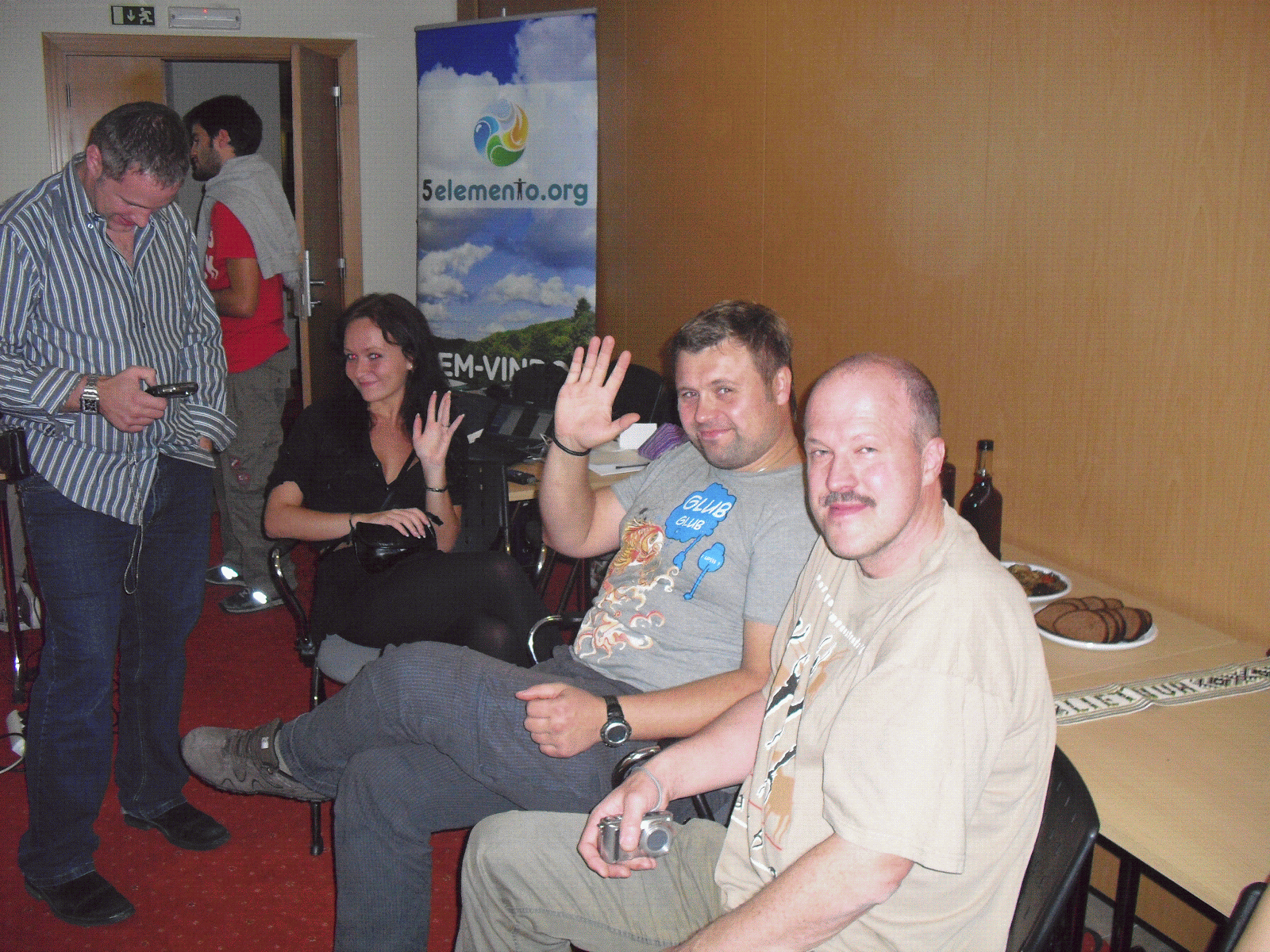
To close up these posts about the Grundtvig Workshop on Sustainable Energy I'd like to share some photos taken by Anthony during his week in Lisbon with the new friends he made from all over Europe. 

  • The Participants of the Workshop, from Italy, Latvia, Bulgaria, Romania, Hungary, Lithuanian and, of course, Malta. 
  • A sack race competition with a twist! 
  • Chiara (Italy) and Ivelina (Bulgaria) trying out some experiments at the Museum of Electricity. 
  • Pedro (Portugal) trying out a solar powered car, not a ferrari, but it works! 
  • Jose (Portugal) carrying out some energy experiments and debunking some energy myths. 
  • Ulderica, Stefano, Chiara and Fabrizio, the Italians during the inter-cultural evening. 
  • Raimond, Annija, Ivo and Juris (all from Latvia) during the inter-cutural night. 
For more info on 5elemento, the NGO that organised the fantastic workshop, or the workshop itself visit 5elemento.org or contact Greenhouse (green.uom@gmail.com) 

Sunday, 5 December 2010

Anthony's Trail: A Visit to Edificio Solar XXI

While I (Anthony) was in Lisbon on the Grundtvig Workshop with 5elemento, we visited an interesting "passive building" called Edificio Solar XXI. This is a building which was designed to use very little energy, virtually no external energy is used in the building. 


They did this by incoporating a variety of technology including: 
  • advanced insulation systems
  • innovative ventilation 
  • clever design of blinds and apertures to provide as much natural lighting as possible
  • solar collectors for heating water
  • photovoltaic cells, both on the wall of the building and also on the parking area (this serves as an energy source and also a shelter for cars!) 
  • earth tubes for passive cooling
  • a ventilation system which serves as heating thanks to the photovolatic cells 
  • and much more clever ideas! 

Check out the powerpoint presentation attached for an explanation on how the building was designed. This was presented to the participants of the workshop by one of the engineers that works in the building.


Ed Solarxxi 5elemento

Sunday, 28 November 2010

Anthony's Trail: Ivo's Greenhouse


In the previous Blog post we shared some hints and tips on how to reduce your energy consumption in the home. This helpful information was passed on by Anthony (Greenhouse member) who attended a Grudtvig workshop in Lisbon, which was organised by a certain 5elemento, a Portugese NGO that focuses on sustainable energy and much of the information and presentations published in the recent blogs were prepared by Jose and Pedro, our friends from 5elemento. 
So, we've already seen what little things we can do to make our homes more energy efficient without spending much time or effort on it. 
Now, I'd like to introduce Ivo:
(Put pic 2 here)
Ivo is from Kuldiga in Latvia, a country were the temperature is below 0'C for most of the year and where it often goes below -40'C. This kind of climate is very hard to imagine for people who live in a country with such a mild climate, where we never ever have sub-zero temperatures (except for in walk-in freezers!). To get an idea of what it's like in Latvia in winter, the water pipes often freeze up during the worst part of the winter. Soil often freezes for the metre or so under ground. Let's just say it's pretty difficult to keep warm. 
Ivo had an incredible idea. He decided to build his own home from scratch. Apart from the daunting idea of designing building a timber house from scratch, only with the help of family and friends, Ivo also decided to make his home as energy efficient as humanly possible. He knew this would entail a lot of planning, hard work and a good bit of money, but he didn't let that get him down and he went for it. 

One of the most important aspects that Ivo had to consider when designing his house was good insulation. He used a type of insulation very popular in Baltic States called ISOPLAAT which is a composite material which provides very effective insulation. The photo shows Ivo's wife admiring the ISOPLAAT on the half-constructed house. He also used some interesting methods of heating, he built his own floor heating (shown in the next photo) and also created a great system for his furnace which circulated the whole house. 


When asked whether it was honestly worth all the work to create an energy efficient home he replied simply, "100%". 


Here's a powerpoint presentation about Ivo's Green-house, in which he explains how he carried out this great work, with details on the insulation, heating systems and chimneys. 


Ivo's Home Pt 1

Ivo's Home Pt 2

Monday, 22 November 2010

Biodiversity concern on the rise in the European Parliament

Lately, the European Parliament passed a Motion for a Resolution which wasn’t given enough emphasis and perhaps rightly because it is rife with rhetoric. Nonetheless, this motion which centered around biodiversity, had some points worth mentioning and it would be good if we reproduce some of the things agreed by the MEPs on this motion namely:


  1. The European Parliament (EP) slammed Japan for its prevention of protecting the blue fin tuna at a high-level meeting it hosted to discuss the Convention on Biological Diversity.
  2. The EP was of the view that decisions to be taken at the next COP (the high-level meeting between heads of state to discuss the way forward with regards to climate change) must reflect the findings of the TEEB (a study which is giving monetary equivalence to ecosystem services, species, habitats etc.) and that the costs of biodiversity loss and the value of biodiversity need to be reflected in national accounts;
  3. By 2020, subsidies harmful to biodiversity are eliminated, there is zero net deforestation, pressure on marine ecosystems through overfishing is halted, the introduction and establishment of invasive species are halted, at least 20% of land, fresh water and sea areas are protected, 15%of degraded ecosystems are restored;
  4. Business engagement should include not only voluntary commitments but also obligations;
  5. Member States should develop innovative systems for payment of ecosystem services and mobilizing private financing;
  6. IN INTERNATIONAL TRADE AGREEMENTS SUSTAINABILITY OF THE PRODUCTS BEING TRADED IS A KEY ELEMENT AND THEREFORE THERE IS THE NEED TO INCLUDE PRODUCTION METHODS AND RESPECT FOR BIODIVERSITY IN ANY FUTURE WTO AGREEMENT.


ALL MALTESE MEPs VOTED IN FAVOR OF THIS MOTION FOR RESOLUTION.


The majority of MEPs voted in favor and thus was adopted by the Parliament.

Sunday, 21 November 2010

Anthony's Trail: Make your own Green-house!

In a previous blog post we promised that we'd share some hints and tips on how to lower your domestic energy consumption! In Europe, about 75% of the energy used in the home is used for space heating. Luckily, we have a very mild climate here in Malta, but in some other countries the temperature can be in the negative degress celsius for a large part of the year and can go as far down as -40'C. Many countries in Europe have issues such as frozen water pipes during the winter months. In Malta we have more of a space cooling issue in summer than a space heating issue in winter. That said, I've heard many people complain that they feel cold inside their homes in winter, despite having the AC, electric radiators or gas heaters on and I suspect that that has much to do with construction inadequacies. 


Anyway here are some tips on how to lower your energy consumption in the home: 

Change your light bulbs! Energy saving light bulbs can reduce your consumption while not affecting your quality of lighting. Older energy saving bulbs take long to heat up until they reach their full strength, but nowadays there are good bulbs that don't take anytime to heat up, they're just like regular bulbs (but better!). I use 11W energy saving bulbs that shine as much as 60W bulbs and don't take any time to "heat up". Also, it's a good idea to choose the wattage of your bulbs depending on the "activity" you use them for. Identify bulbs you use for reading and ones you need for dim lighting and select appropriate wattages. 


Reduce Vampire Power- this means switching off all equipment from standby. Many people think that this is just a myth, but really, a lot of your energy goes down the drain by leaving music systems, TVs, DVD players, mobile chargers etc etc on standby.
Buy appliances that are rated as energy efficient. Try to aim for A or A+ appliances, these are very common now and most new technology is A or A+. All domestic appliances sold in the EU should be marked with the certificate shown below. Check it - it will save you money. 
Use less energy for heating/cooling: Set the thermostats of your ACs/central heating systems to the lowest temperature which is comfortable, in winter, and the highest temperature which is comfortable, in summer. So in summer your ACs should be set at around 25'C and not 16'C. Setting the AC temperature at too low a temperature puts a lot of strain on the AC unit and is overkill. Also, wear appropriate clothing, indoors, according to the weather: wear several layers in winter and as little clothing as possible (while remaining decent!) in summer. 


    That's just the beginning. Check out the presentations, prepared by our friends at 5elemento (a Portugese NGO) attached for a long list of hints and tips for reducing your energy cosumption. Most of these are very simple and don't take any time or money and can save you money on your energy bill.
    Tips 1


    Tips 2

    Sunday, 14 November 2010

    Anthony's Trail: Renewable Energy in the EU

    88.1% of the world's energy comes from fossil fuels (in the EU 82% comes from fossil fuels, while in Malta it's 100% of course). The average person uses 2584 kwh however 77% of the world's energy is consumed by just 28% of the population. The European Union has long been trying to lower energy consumption and reduce reliance on fossil fuels, for two main reasons: 
    1. Environmental Issues (such as global warming, health effects of pollution & the damage that pollution causes to ecosystems) 
    2. Energy Dependency (most of the Union's fossil fuels are imported, resulting in a resource dependency). 


    Regarding the Environmental concerns, most of the EU member states had signed the Kyoto protocol, back in 1997, and many (15) have actually carried out the necessary cuts and measures which they promised they would, with Latvia ranking on top, cutting emissions to 48% lower than the Kyoto target. As you can see in the first graph, many countries didn't quite make the cut. Of course Malta is down at the bottom of the list alongside Cyprus for not having actually signed the protocol! 

    As for the dependency concern, Malta of course imports 100% of it's energy in the form of fossil fuels and is on the top of the list in the second chart, again alongside our friends Cyprus. 


    The EU aims to solve the problem of emissions and dependency with a two-pronged approach: reducing consumption and investing in renewable energy sources. The general public seems to have certain reservations on renewable energy in their homes, mainly because a lot of the choices (such as Photovoltaic cells and Wind Turbines) are pretty expensive! But, there are practical and easy ways to reduce your energy consumption in the home and also use more renewable forms of energy.

    In the coming blog posts we'll give some simple hints and tips as to how to lower your energy bill and help save the enviornment at the same time and also share some ideas and experiences with you. 

    Check out the powerpoint presentation, prepared by members of 5elemento (www.5elemento.org), about the state of energy in the EU. 


    Energy in the World

    Tuesday, 18 May 2010

    Chronicles of Simi - O Boje! He’s at it again

    Here we hope to start the Chronicles of Simi. An adventurous personally from the Greenhouse team whose perseverance in tackling some of the most daring issues we face in our daily life Inspires us all (the regular Greenhouser). Her adventure takes place in Bulgaria where she is engaged daily in research and experiments for her Masters! She is also the Author of our Propolis blog and Co-editor of the Magazine Wink (World Inclusiveness).

    O Boje! He’s at it again

    My toilet is strange creature, one minute he’s behaving himself, the next his flushing leaking (into the toilet basin) and keeps on going and going and going ... you get the idea :P I’ve hardly ever even seen the inside of a flushing (hehe well I have thanks to Greenhouse’s bottle/flushing project ;)). Anyways, the first time I just lifted the lid of the flushing and put it back on a bit forcibly thinking that it would work some miracles, and hey! It did! The flushing behaved instantly!

    I thought that was the end of it, but little did I know that that bastard of a flushing had other things in mind!

    The next day, just before leaving to catch the bus (auftobus) he was at it again!! O BOJE! (which means OMG)

    I went into the bathroom, confident that I had the solution in hand. Open lid. Put it back again a bit forcibly and voila! Or maybe not! Grrr! Well I was just in time to catch the auftobus and I was not going to miss it, so I just gave him an ugly look and left.

    I come back, having forgotten about the bloody toilet and as soon as I open the front door *sound of water trickling and some hissing*! AAAAAAA! I just went in, closed the bathroom door (to lessen the noise) and went to cook hoping that the flushing would tire of this game and stop. Hehe I wish!

    Went to sleep. Woke up. Flushing still going at it!

    Now I was determined to do something about it! Haqqa a porcelain inanimate object will not win! I got some disposable gloves out (dawk tal-lab- thanks ma :D). Removed all the early morning hair fuzz from my eyes and was ready to enter the battle ground.

    Hehe, I opened the toilet lid and started pocking round the bits and pieces ;) I was going to sketch a drawing of the internal workings of the flushing, but I don’t think you would be too excited to see that ;) I was lucky enough that the first think I lifted ended the noise/trickling of water! WOW! Simone you’re good e ;)

    I put the lid on, thinking this was really and truly the end of it, pushed the flushing button and ... nothing! Haha! The irony! First he keeps on trickling water all throughout the day and night, now he is as dry as a desert! Bastard.

    I put on the gloves again, open the lid, and this time I spend a little time trying the understand how the mechanism works! Prodding and lifting everything and seeing what their effect is. Basically now I can confidently say I am well trained in fixing flushing problems ;) The problem was that the mechanism which should automatically stop the flushing from leaking any water in the toilet basin (which is automatic) seems to block up sometimes. I released it and for now it seems to be fine.

    So it seems that Mr.Toilet is behaving ... for now J

    Thursday, 8 April 2010

    Rediscovering natural medicine

    Some time ago, (yes this is a long awaited blog!) Malcolm and I (Monique) attended a talk on natural medicine, which was hosted by Ayur Veda Wellbeing in St. Venera. Greeted with either herbal tea or Acai berry juice, we settled down quietly for an hour long talk which was delivered by Ruben Bartolo who works as a naturopath.
    Naturopathy is a medicinal system based on the healing power of nature. The approach of the naturopath is rather a holistic one, by which he tries to understand the body, mind, and spirit when dealing with a disease. The naturopath does not treat the disease but the person. Naturopaths use herbal medicine, acupuncture, iridology and clinical nutrition.

    The naturopath helps the person in supporting one’s own healing abilities and empowering him to make the necessary changes for a healthier lifestyle. Naturopathy is a broad treatment system which is free of drug use, which came about as a medical system over time. It was present in different cultures and places all over the world, becoming very popular in Europe especially in the 19th century Germany. It was further developed in late 19th and early 20th century in the United States.

    Central to naturopathy is the vis medicatrix naturae, nature’s healing power followed by primum non nocere and tolle causam. Nature’s healing power is inherent self-organizing and the healing process of the living systems. It establishes, maintains and restores health. The naturopath’s role is to support the creation of a healthy internal and external environment. Primum non nocere refers to first do no harm; this is a fundamental principle in naturopathic practice. Tolle causam refers to the treatment of causes of disease rather than the symptoms contrary to conventional medicine.

    Mr Bartolo then spoke about clinical nutrition, iridology, traditional herbal medicine, and homeopathic medicine which I shall be describing briefly below. Clinical nutrition is based on the relationship between the disease and the nutrition. The naturopath helps the person improve one’s diets and changing them according to one’s lifestyle. Nutritional counselling and support is one of the major components of Mr Bartolo’s treatments.


    Iridology is an alternative medicinal practice studying the iris of the eye by examining the patterns, colours and other characteristics. Scientific evidence for this practice is very limited; the link between aspects of the iris and patient’s state of health is not yet established scientifically. Iridologists or naturopaths trained in iridology, highlight organs or systems which are healthy and ones that are inflamed. Their general equipment is a flashlight and magnifying glass, cameras or slit lamp microscopes. The patterns are compared to a chart that is used to correlate specific zones of the iris with specific parts of the body.

    Traditional herbal medicine or phytotherapy, comes as a tincture, syrup or capsules. The therapeutic properties of a plant can be extracted from any part of the plants. Fans of green tea, might not know that green tea and green tea extracts have been used to prevent and treat a variety of cancers. It is also used for improving mental awareness and lowering cholesterol levels. Scientifically, studies have suggested that it may help protect against or slow the growth of certain cancer. It also suggested that its caffeine content can contribute to improving mental awareness. The data with regards the lowering blood cholesterol levels is not reliable yet.


    Homeopathic medicine which is produced from plants, animals and minerals fall under the practice of homeopathy. Samuel Hahnemann standardized the practice in 18th century Germany. It is based on the Principles of Similars, where like treat like. By using infinitesimal amounts of substances which cause similar symptoms to that which is being treated results in a treatment free from side effects and increased therapeutic effect. This process of diluting is referred to as potentization. The homeopaths use only the homeopathic approach unlike the naturopaths which train in several forms of diagnosis and treatment, including homeopathy.

    Unlike alternative medicine, conventional western medicine treats diseases and not people. The drugs are designed to prevent cells of the body from performing some function that is it carrying out abnormally. The drugs have a number of undesired side effects and may be fatal. By saying this I would not like to imply that one should use only alternative medicine. Alternative medicine has been controversial since it is sometimes very limited when it comes to scientific back up. Thus it has been renamed to complimentary alternative medicine. As it complements the conventional western medicine.

    References:

    Iridology. Retrieved online from http://www.crystalinks.com/iridology.html

    Guild of Naturopathic Iridologists International. About iridology. Retrieved online from http://www.gni-international.org/about-iridology1.htm

    Herbs at a glance: Green Tea. Retrieved online from http://nccam.nih.gov/health/greentea/index.htm.

    Russo Tarascio, J. Naturopath Vs. Homeopath. Retrieved online from http://www.ehow.com/about_5417341_naturopath-vs-homeopath.html

    Principles of Naturopathic Medicine. Retrieved online from http://www.naturodoc.com/cardinal/naturopathy/nat_principles.htm

    University of Maryland Medical Centre (2009) Naturopathy. Retrieved online from http://www.umm.edu/altmed/articles/naturopathy-000356.htm

    Ayur Veda Wellbeing on FaceBook

    Monday, 5 April 2010

    Young Entrepreneurs and their green credentials

    Early in the morning before the start of a very long day Malcolm and I visited what was an exhibition of ‘Young Enterprise’ business ideas and their implementation. Keen to discover how teenagers take into consideration the environmental aspect of a business venture when taking such an entrepreneurial task we approached each stand to give ourselves a clearer picture by engaging with the entrepreneurs themselves.

    Here I will try to explain the prime products which had what we often call ‘green’ credentials.

    The Multiplat

    A product purely made out of recycled glass. The idea is simple. Turn your wine bottle into a platter or a decoration by ‘flattening it out’. Instead of feeding the product into our waste stream, the company reengineers the bottle to serve another day on our tables. The idea is simple and catchy whilst also visionary in the way our own waste is also reintroduced even to the table where we dine.

    GLAZED

    Merging a number of waste materials together might be the best way to be innovative in your approach towards reusing waste. Here the young enterprise ‘GLAZED’ mixed two main materials namely wine boxes and old sheets. After giving shape to the wood pieces based on the client’s needs the cloth is wrapped around it and glazed thereby making it durable and even customised as no one piece of cloth is identical to the other. The idea is creative and the end product can be customised to the clients need.

    Koncentrik

    Looking at the company Koncentrik this made use of Ice Tea bottle caps and turned them into earphones rollers/containers. These are cylindrical covers for ones earphones and are made from two Ice tea caps screwed together. When not making use of your earphones these can be easily rolled into the Ice Tea container which is just pocket size. All materials are from waste sources and this is yet another example of inventive use of waste material by the young entrepreneurs present at the fair.

    Eco-log

    Following the numerous forestation projects which tend to be mainly characterised by olive tree planting which by-product can be used from these trees which can easily be found in bulk? Eco-log is a form of ‘firewood’ so to speak which is made of the olive residue in the olive oil production processes. It has a higher calorific value than the regular firewood due to its oil contents and it’s easier to start up. The product itself is new and quite fresh to the market. It is unaltered from any chemical additives to help its combustion as it is purely the result of considerable pressure on the by-product.


    www.ecologmalta.com

    These are just some discoveries of how even waste can be remodelled to serve once again before it is recycled or treated.


    Read More: http://www.independent.com.mt/news.asp?newsitemid=104006


    Tuesday, 23 March 2010

    What Sovereignty is all about... Food and Nutrition!

    Recently I attended a conference in Gozo with the subject: ‘Organic Agriculture and Eco-Gozo’ organized by, amongst others, MOAM (Malta Organic Agricultural Movement), IFOAM (International Federation of Organic Agricultural Movements) and the Ministry for Gozo.

    I must say that it was an incredibly informative and interesting conference with some top speakers delivering very educational and provoking talks. These included Olafur R Dyrmundsson from Iceland which discussed the challenges faced by a small island state, Leen Laenens (Belgium) which explored the topic of seed diversity and the farmers’ rights to them, Anamarija Slabe (Slovenia) which gave a thorough insight into a low-carbon Slovenia, Eva Acs (Hungary) which spoke about organic agriculture in Hungary and Dr. Alex Beck (Germany) which provided the attendees with a brief introduction on EU Regulation on Labeling of Organic Products.

    But I want to focus on the first talk which was delivered. Christopher Stopes from the UK is the President of the IFOAM UK and gave a very provoking insight into food sovereignty. This is a resume of what was discussed.

    Agriculture is an important economical sector. Tourism, rural development and environmental stewardship are all dependent on this sector. The farmer has many very crucial roles in society including the provision of food and safeguarding the environment.

    We are currently facing an enormous amount of problems not least among them are biodiversity decline, health problems especially with cardiovascular diseases and obesity and climate change.

    Organic agriculture in particular tries to solve many of these problems through its approach and these are varied. In fact the approach is a ‘multifunctional’ approach. Organic agriculture is considerate of culture, well-being, nature, diet, taste, yield, nutrition, soil, water, animal welfare, greenhouse gasses, energy and more.

    We cannot continue with a productionist mindset which pulls the supply chain with it. In fact, this can be seen in light of ethics- the good/bad- which currently defines production. We need to move away from ethics and more towards ethos- the way we live. By focusing on the latter, ethics will fall into place and production will be seen in its correct context.

    Greenhouse gasses are driving climate change and this is especially driven by meat consumption. There are approximately 5 billion chickens we can’t afford to eat, which are dumped into other markets especially those of developing countries with very low prices, ruining the local supply chain and economical incentive for the locals’ production. For chicken farming, Brazil clears huge swathes of land to provide soya to the EU to feed its chickens. Not only that but the chickens produced are fed so much food to fatten their muscles that their legs usually do not support the weight and collapse.

    We are now facing a resource crisis with peak oil fast approaching (or perhaps past it already?), economic uncertainty that the risks of indefinite growth brings with it and a social blurring of culture.

    We must now differentiate between food security and food sovereignty. Food security is having enough food to eat which is still in the hands of existing powers. Food sovereignty on the other hand gives a human right to adequate food devolving power to the people. We must move towards food sovereignty if we are ever to have an equitable and fair share of our resources and no famine in the world.

    We must move towards…. so that we avoid….

    People’s right to food.... to avoid Export

    Valuing farmers.... to avoid looking at farmers as simply those who farm the land

    Local food systems.... to avoid Global Trade

    Local control.... to avoid remote global competition

    Build real knowledge... to avoid relying on alien technology e.g. GMOs

    Work with nature.... to avoid Harming ecosystems


    We now move to another very interesting concept which was discussed in the same talk which is that of eco-nutrition: eating and drinking with ecology, animal welfare, community and social justice and equity in mind. In brief, this is what is recommended for this purpose:

    1. Eat less but better- go for quality
    2. Eat simple
    3. Do NOT diet
    4. Eat no more than you expend in energy
    5. Eat equitably- don’t take food out of another’s mouth
    6. Feast for celebration
    7. Eat seasonally where possible
    8. Support local suppliers
    9. Learn to cook
    10. Pay full costs of producing and transporting food- if you don’t others will
    11. Celebrate varieties- get diversity into field and plate: aim for 20-30 plant species a week
    12. Think fossil fuels embedded in the food (transport etc.)
    13. Drink water not soft-drinks
    14. Be aware of hidden ingredients- unnecessary salts, sugars and additives
    15. Enjoy food but think long-term impact
    16. Eat a plant-based diet
    17. If you eat fish or meat choose those that have run/swam as wild and free as possible

    Food sovereignity coupled with eco-nutrition are surely food for thought. What we have in our plate has a history- it can be one of bondage, struggle and degradation possibly with adverse health impacts when consumed or a history of equity, harmony with nutritious benefits when eaten. The food you eat is one of the very few things you decide for your own. You can stop at KFC or catch a bus home to make a salad. Your choice…