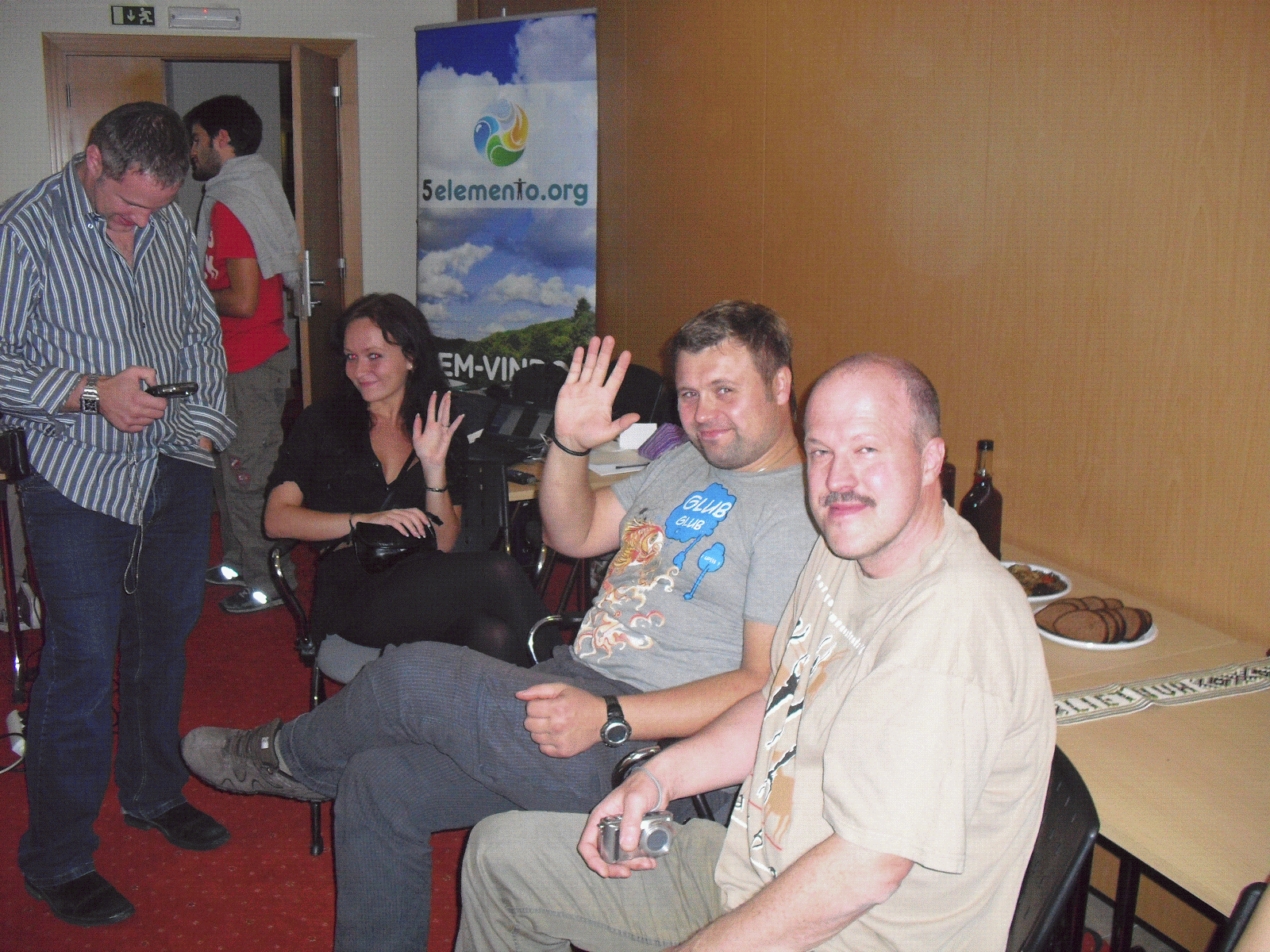
To close up these posts about the Grundtvig Workshop on Sustainable Energy I'd like to share some photos taken by Anthony during his week in Lisbon with the new friends he made from all over Europe.
The Participants of the Workshop, from Italy, Latvia, Bulgaria, Romania, Hungary, Lithuanian and, of course, Malta.
A sack race competition with a twist!
Chiara (Italy) and Ivelina (Bulgaria) trying out some experiments at the Museum of Electricity.
Pedro (Portugal) trying out a solar powered car, not a ferrari, but it works!
Jose (Portugal) carrying out some energy experiments and debunking some energy myths.
Ulderica, Stefano, Chiara and Fabrizio, the Italians during the inter-cultural evening.
Raimond, Annija, Ivo and Juris (all from Latvia) during the inter-cutural night.
For more info on 5elemento, the NGO that organised the fantastic workshop, or the workshop itself visit 5elemento.org or contact Greenhouse (green.uom@gmail.com)
While I (Anthony) was in Lisbon on the Grundtvig Workshop with 5elemento, we visited an interesting "passive building" called Edificio Solar XXI. This is a building which was designed to use very little energy, virtually no external energy is used in the building.
They did this by incoporating a variety of technology including:
advanced insulation systems
innovative ventilation
clever design of blinds and apertures to provide as much natural lighting as possible
solar collectors for heating water
photovoltaic cells, both on the wall of the building and also on the parking area (this serves as an energy source and also a shelter for cars!)
earth tubes for passive cooling
a ventilation system which serves as heating thanks to the photovolatic cells
and much more clever ideas!
Check out the powerpoint presentation attached for an explanation on how the building was designed. This was presented to the participants of the workshop by one of the engineers that works in the building.
In the previous Blog post we shared some hints and tips on how to reduce your energy consumption in the home. This helpful information was passed on by Anthony (Greenhouse member) who attended a Grudtvig workshop in Lisbon, which was organised by a certain 5elemento, a Portugese NGO that focuses on sustainable energy and much of the information and presentations published in the recent blogs were prepared by Jose and Pedro, our friends from 5elemento.
So, we've already seen what little things we can do to make our homes more energy efficient without spending much time or effort on it.
Now, I'd like to introduceIvo:
(Put pic 2 here)
Ivo is from Kuldiga in Latvia, a country were the temperature is below 0'C for most of the year and where it often goes below -40'C. This kind of climate is very hard to imagine for people who live in a country with such a mild climate, where we never ever have sub-zero temperatures (except for in walk-in freezers!). To get an idea of what it's like in Latvia in winter, the water pipes often freeze up during the worst part of the winter. Soil often freezes for the metre or so under ground. Let's just say it's pretty difficult to keep warm.
Ivo had an incredible idea. He decided to build his own home from scratch. Apart from the daunting idea of designing building a timber house from scratch, only with the help of family and friends, Ivo also decided to make his home as energy efficient as humanly possible. He knew this would entail a lot of planning, hard work and a good bit of money, but he didn't let that get him down and he went for it.
One of the most important aspects that Ivo had to consider when designing his house was good insulation. He used a type of insulation very popular in Baltic States called ISOPLAAT which is a composite material which provides very effective insulation. The photo shows Ivo's wife admiring the ISOPLAAT on the half-constructed house. He also used some interesting methods of heating, he built his own floor heating (shown in the next photo) and also created a great system for his furnace which circulated the whole house.
When asked whether it was honestly worth all the work to create an energy efficient home he replied simply, "100%".
Here's a powerpoint presentation about Ivo's Green-house, in which he explains how he carried out this great work, with details on the insulation, heating systems and chimneys.
In a previous blog post we promised that we'd share some hints and tips on how to lower your domestic energy consumption! In Europe, about 75% of the energy used in the home is used for space heating. Luckily, we have a very mild climate here in Malta, but in some other countries the temperature can be in the negative degress celsius for a large part of the year and can go as far down as -40'C. Many countries in Europe have issues such as frozen water pipes during the winter months. In Malta we have more of a space cooling issue in summer than a space heating issue in winter. That said, I've heard many people complain that they feel cold inside their homes in winter, despite having the AC, electric radiators or gas heaters on and I suspect that that has much to do with construction inadequacies.
Anyway here are some tips on how to lower your energy consumption in the home:
Change your light bulbs! Energy saving light bulbs can reduce your consumption while not affecting your quality of lighting. Older energy saving bulbs take long to heat up until they reach their full strength, but nowadays there are good bulbs that don't take anytime to heat up, they're just like regular bulbs (but better!). I use 11W energy saving bulbs that shine as much as 60W bulbs and don't take any time to "heat up". Also, it's a good idea to choose the wattage of your bulbs depending on the "activity" you use them for. Identify bulbs you use for reading and ones you need for dim lighting and select appropriate wattages.
Reduce Vampire Power- this means switching off all equipment from standby. Many people think that this is just a myth, but really, a lot of your energy goes down the drain by leaving music systems, TVs, DVD players, mobile chargers etc etc on standby.
Buy appliances that are rated as energy efficient. Try to aim for A or A+ appliances, these are very common now and most new technology is A or A+. All domestic appliances sold in the EU should be marked with the certificate shown below. Check it - it will save you money.
Use less energy for heating/cooling: Set the thermostats of your ACs/central heating systems to the lowest temperature which is comfortable, in winter, and the highest temperature which is comfortable, in summer. So in summer your ACs should be set at around 25'C and not 16'C. Setting the AC temperature at too low a temperature puts a lot of strain on the AC unit and is overkill. Also, wear appropriate clothing, indoors, according to the weather: wear several layers in winter and as little clothing as possible (while remaining decent!) in summer.
That's just the beginning. Check out the presentations, prepared by our friends at 5elemento (a Portugese NGO) attached for a long list of hints and tips for reducing your energy cosumption. Most of these are very simple and don't take any time or money and can save you money on your energy bill.
88.1% of the world's energy comes from fossil fuels (in the EU 82% comes from fossil fuels, while in Malta it's 100% of course). The average person uses 2584 kwh however 77% of the world's energy is consumed by just 28% of the population. The European Union has long been trying to lower energy consumption and reduce reliance on fossil fuels, for two main reasons:
Environmental Issues (such as global warming, health effects of pollution & the damage that pollution causes to ecosystems)
Energy Dependency (most of the Union's fossil fuels are imported, resulting in a resource dependency).
Regarding the Environmental concerns, most of the EU member states had signed the Kyoto protocol, back in 1997, and many (15) have actually carried out the necessary cuts and measures which they promised they would, with Latvia ranking on top, cutting emissions to 48% lower than the Kyoto target. As you can see in the first graph, many countries didn't quite make the cut. Of course Malta is down at the bottom of the list alongside Cyprus for not having actually signed the protocol!
As for the dependency concern, Malta of course imports 100% of it's energy in the form of fossil fuels and is on the top of the list in the second chart, again alongside our friends Cyprus.
The EU aims to solve the problem of emissions and dependency with a two-pronged approach: reducing consumption and investing in renewable energy sources. The general public seems to have certain reservations on renewable energy in their homes, mainly because a lot of the choices (such as Photovoltaic cells and Wind Turbines) are pretty expensive! But, there are practical and easy ways to reduce your energy consumption in the home and also use more renewable forms of energy.
In the coming blog posts we'll give some simple hints and tips as to how to lower your energy bill and help save the enviornment at the same time and also share some ideas and experiences with you.
Check out the powerpoint presentation, prepared by members of 5elemento (www.5elemento.org), about the state of energy in the EU.
Anthony, a member of the Greenhouse Exec. had the opportunity to travel to Lisbon to take part in a Grundtvig workshop (http://ec.europa.eu/education/grundtvig/doc984_en.htm) organised by Portugese NGO 5elementos (the fifth element). The workshop was attended by 15 participants from all over Europe (Italy, Latvia, Hungary, Bulgaria, Romania, Lithuania and, of course, Malta) and the topic of the workshop was sustainable energy, principally in the home.
We will be posting some of the information and experiences from this workshop here, so watch this space!
To start off with here's a link (www.casamais.adene.pt) to an interactive program which allows you to calculate your house's/apartment's energy efficiency and also determine what your problem areas are and what impacts certain changes will have on your energy efficiency. The program is designed for Portugal, allowing you to choose from different regions of Portugal thus customising the environmental conditions. I suppose that selecting a region in the south of Portugal is the best way of approximating Malta's climatic conditions however maybe in the future we will have a similar programme designed for our little islands!





 Posts
Posts

